Conveyor Equipment
GZS Series Efficient Linear Vibrating Screen
The GZG series vibrating feeder is a universal vibrating motor-driven feeding equipment developed and produced by our company. Widely used in mining, metallurgy, coal, glass, building materials, light industry, chemical industry, power, grain and other industries, it is used to continuously and uniformly feed block, granular and powdery materials from storage warehouses or funnels to the receiving device.Product features and scope of use1. Simple structure, large processing capacity, simple structure, relatively easy installation and maintenance.2. Stable vibration, reliable operation, long service life, etc3. There are two installation methods: hanging and seated.4. The vibration source of the heavy-duty vibrating feeder can be equipped with an exciter form.5. Can be lined with wear-resistant lining plates such as manganese steel and ceramics5. The material conveying distance can be extended according to customer needs.Main technical parametersTypeProcessingcapacity (t/h)Maximum granularity (mm)Amplitude (mm) Electric motorHorizontalTiltedRotation speed(rpm)Power(kw)GZG40-904045803-515002×0.25GZG50-10055561002×0.4GZG60-12075901202×0.4GZG70-1401001151504-610002×0.55GZG80-1401301501502×0.55GZG90-1501702002402×0.75GZG100-1602603002602×1.1GZG120-1603303803002×1.5GZG150-1805606203002×2.2GZG180-1807008503502×3GZG200-200100012003502×3.7
Conveyor Equipment
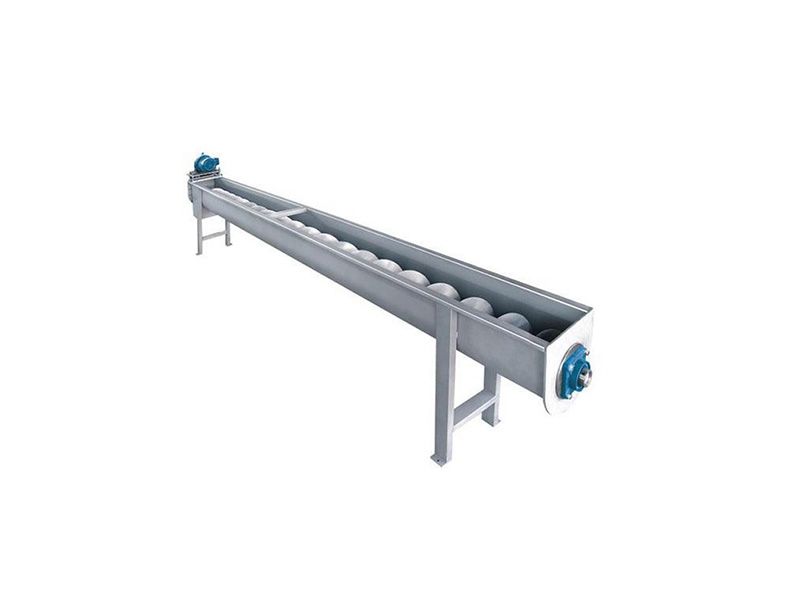
LS Series Screw Conveyors
A screw conveyor is mainly used for conveying various powdery, granular and small lump materials in a loose state. This machine is not suitable for conveying materials that are prone to spoilage, high viscosity, easy to agglomerate, high temperature, sensitive to pressure, and have significant corrosiveness. In terms of appearance, it can be divided into U-shaped screw conveyor and pipe screw conveyor. In terms of installation method, it can be divided into horizontal, inclined and vertical types. The material can be carbon steel, 304, 316L, 321, etc.Main technical parametersTypeSpiral diameter(mm)Screw distance(mm)Rotation speed(r/min)Conveyancerate(m³/h)Rotation speed(r/min)Conveyancerate(m³/h)Rotation speed(r/min)Conveyance   rate(m³/h)Rotation speed(r/min)Conveyance rate(m³/h)LS1001001001402.21121.7901.4711.1LS1601601601128907716504LS2002002001001480129310507LS2502502509024712056164513LS315315315803463265021406LS4004003557164565245413634LS50050040063100508040643252LS630630450501454011632942580LS80080050040208321652513020110LS1000100056032300252302018016150LS1250125063025388203201626013200 The listed parameters in the table are reference values for standard products under normal conditions and rated operating conditions. The parameters only reflect the main structural types and dimensions of the equipment. They are provided for users to refer to when selecting equipment models. The specific structure and main technical parameters are subject to the technical and supply contract.
Conveyor Equipment
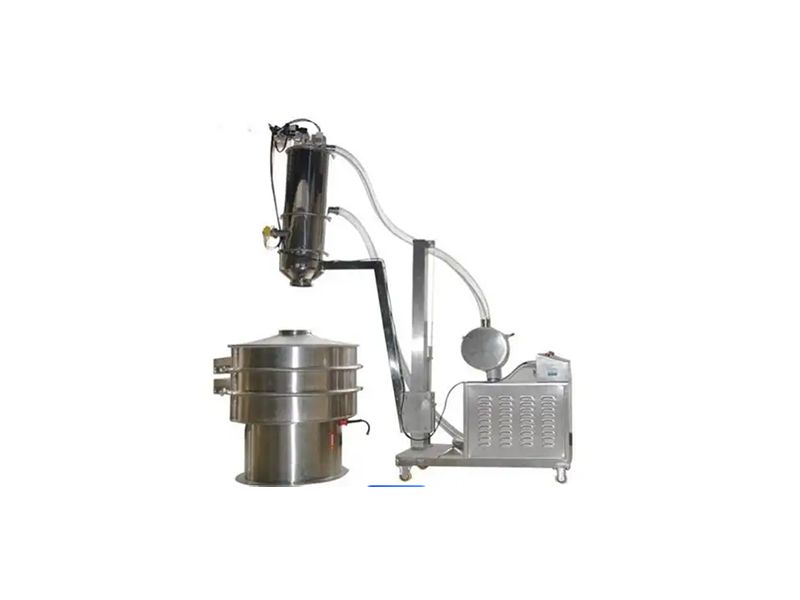
ZKS Vacuum Conveying System
ZKS Vacuum Conveying System is a vacuum conveying machine that uses a vacuum pump to generate a vacuum source. This causes the suction nozzle and the entire system to be in a certain vacuum state, and the powder or granular material is sucked in along with the ambient air into the suction nozzle, forming a material-air flow that is directly sent into a closed container (such as a V-type mixer, a three-dimensional mixer, a two-dimensional mixer, an inclined mixer, or a closed material bin) for automated, dust-free material handling. It can be used in conjunction with various packaging machines, crushers, vibrating screens, mixers, etc.Main technical parametersTypePower(kw)Conveyance rate(kg/h)Conveying Distance(m)ZKS-11.5200-4005m以内 ZKS-22.2300-600ZKS-33400-1200ZKS-45.5800-2500ZKS-65.51000-3200ZKS-77.52000-4000 ZKS-10-67.52000-600010m以内 ZKS-20-5112000-600020m以内ZKS-4505.5KW2000-600030m以内ZKS-6507.5KW2000-600050m以内ZKS-80011KW2000-6000100m以内Note: Conveying distance = horizontal distance + vertical height, the conveying distance doubles while the conveying capacity halves, and the material's fluidity and characteristics have a significant impact on conveying capacity.

TOP